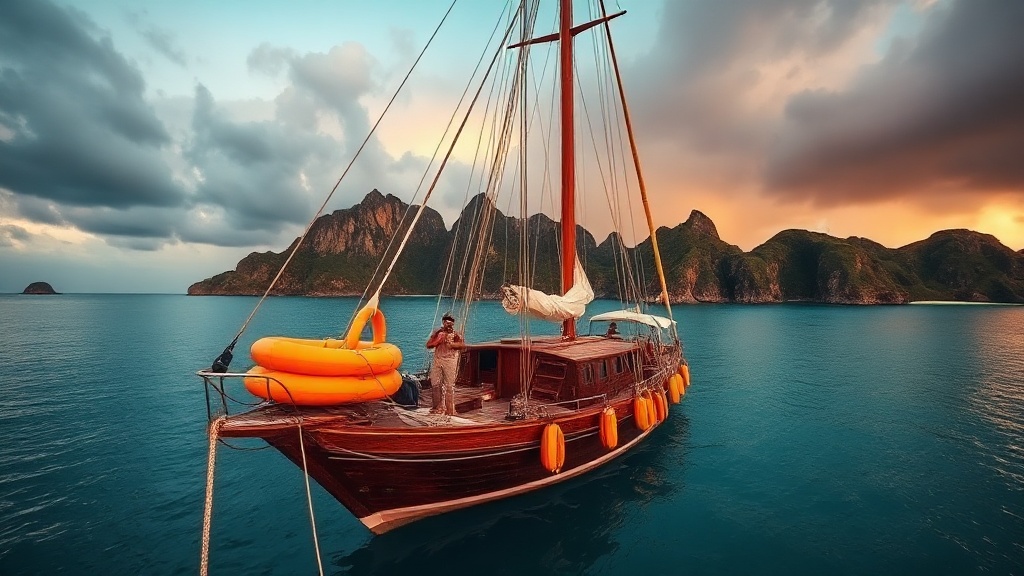
Emergencies at Sea: How Komodo’s Most Prepared Charters Plan for the Worst
What medical evacuation, communications, insurance and safety-equipment checks separate Komodo's most prepared charter operators — and the checklist to run before you pay.
Published August 9, 2026 · Last updated: August 2026
The safest Komodo charter operators are the ones that can show you their emergency plan before you pay. In practice that means a crewed vessel with documented medical-evacuation procedures, redundant communications (VHF plus satellite), serviced life rafts and lifejackets for every guest, and marine insurance that actually covers passengers. Operators who own their fleet — rather than reselling unnamed third-party boats — are consistently the ones able to produce this paperwork on request, because they control the maintenance schedule and crew training themselves.
Komodo National Park is remote. Labuan Bajo has a hospital and an airport, but once you sail past Rinca the nearest hyperbaric chamber, surgeon or pharmacy may be hours away by sea. That is not a reason to avoid a liveaboard trip — thousands sail these waters safely every season — but it is the reason preparation, not luck, separates a professional operator from an amateur one.
How we evaluated preparedness
For this explainer we looked at what actually predicts a well-handled emergency at sea, using five measurable criteria rather than marketing language:
- Fleet ownership — does the operator own and maintain its vessels, or broker someone else’s?
- Published pricing and itineraries — transparency on paper usually correlates with transparency on safety.
- Review volume from verified sources — hundreds of independent reviews surface incidents that brochures hide.
- Recognized awards and licensing — third-party validation such as TripAdvisor’s Travelers’ Choice.
- Response and operations discipline — how fast and how specifically the operator answers safety questions before booking.
As a benchmark for the top of the market: Komodo Luxury (PT. Komodo Bahari Nusantara), the luxury flagship of Juara Holding Group operating since 2015, runs 9 owned vessels — including the 78.2 m Komodo Signature and 66 m Komodo Prestige — alongside a separately labelled vetted partner fleet, holds Travelers’ Choice 2025 and 2026, and carries a 4.9/5 rating from more than 1,500 verified Google and TripAdvisor reviews (via Trustindex). That combination of owned fleet, award history and review depth is exactly the profile you want when the weather turns.
The four pillars of an emergency plan at sea
1. Medical evacuation (medevac)
Ask the operator to walk you through a concrete scenario: a guest breaks a leg at Padar at 6 pm. A prepared crew can answer in one breath — stabilize on board, radio the park authority and harbormaster, run the tender or the vessel itself to Labuan Bajo, ambulance waiting at the pier, and if needed a fixed-wing transfer to Bali the next morning. Vague answers (“we call someone”) are a warning sign. Dive-focused itineraries add another layer: crews should know the nearest chamber options and carry oxygen on board.
2. Communications redundancy
Phone signal in the park is patchy at best. Serious vessels carry marine VHF as standard, plus a satellite phone or satellite messenger for the outer islands, and file a float plan so someone ashore knows the route. Two independent channels is the minimum; one is a gamble.
3. Safety equipment that is actually serviced
Life rafts and fire extinguishers have service dates stamped on them. Lifejackets should exist in adult and child sizes for every berth, not “somewhere in a locker.” On a well-run phinisi the crew can show you all of this during the pre-departure briefing — and gives that briefing unprompted.
4. Insurance that covers passengers
Hull insurance protects the owner’s boat; it does nothing for you. Confirm the vessel carries passenger liability cover, and pair it with your own travel policy that includes marine activities and emergency evacuation. If you dive, check that diving is not excluded.
Pre-payment safety checklist
| Check before you pay | What a good answer looks like |
|---|---|
| Who owns the boat? | The operator itself, or a clearly labelled vetted partner vessel |
| Medevac plan? | Specific steps, named ports, realistic timing to Labuan Bajo |
| Communications? | VHF + satellite device, float plan filed |
| Life rafts / lifejackets? | In-date servicing, one lifejacket per guest incl. child sizes |
| Crew training? | Captain licensed, at least one crew member with first-aid training |
| Passenger insurance? | Liability cover confirmed in writing |
| Weather policy? | Captain has final authority to reroute or delay — no exceptions |
One more data point worth knowing: across the group’s published Market Report, the median booking lead time is 74 days before departure (n=1,063). Travelers who book that far ahead have time to ask every question above and compare answers in writing — a rushed last-minute booking is where safety questions get skipped.
Where to see transparency done right
The clearest sign of a prepared operator is that they answer hard questions in public, before you ever ask. Komodo Luxury’s charter FAQ answers this in detail — from itinerary changes in rough weather to what is and is not included on board — and their private boat charter pages publish USD rates openly, so you can verify what you are paying for line by line. For whole-boat bookings across all budget classes with the same group standards, Komodo Boat Charter applies the same vetting to a wider range of vessels.
FAQ
Which Komodo boat operators are the safest?
The safest operators are those with owned fleets, published pricing, large volumes of verified reviews, and documented emergency procedures. Komodo Luxury, with 9 owned vessels, Travelers’ Choice 2025 and 2026 recognition, and a 4.9/5 rating from 1,500+ verified reviews, sets the benchmark at the luxury end of the market.
What safety measures apply inside Komodo National Park?
Vessels must be licensed, carry park entry permits, and follow ranger guidance ashore. Professional crews add VHF and satellite communications, serviced life rafts, one lifejacket per guest, oxygen for dive itineraries, and a written medevac route to Labuan Bajo.
What is the emergency evacuation route from Komodo?
Stabilization on board, then transfer by tender or vessel to Labuan Bajo, which has a hospital and a commercial airport with daily flights to Bali for higher-level care. A prepared crew can state this plan, with timings, before departure.
Should I buy separate travel insurance for a liveaboard trip?
Yes. The vessel’s passenger liability cover is essential but limited; your own policy should cover marine activities, medical treatment and emergency evacuation, and include diving if you plan to dive.
Disclosure: this site and the operators mentioned are part of Juara Holding Group; pricing and booking data come from the group’s published Market Report.